
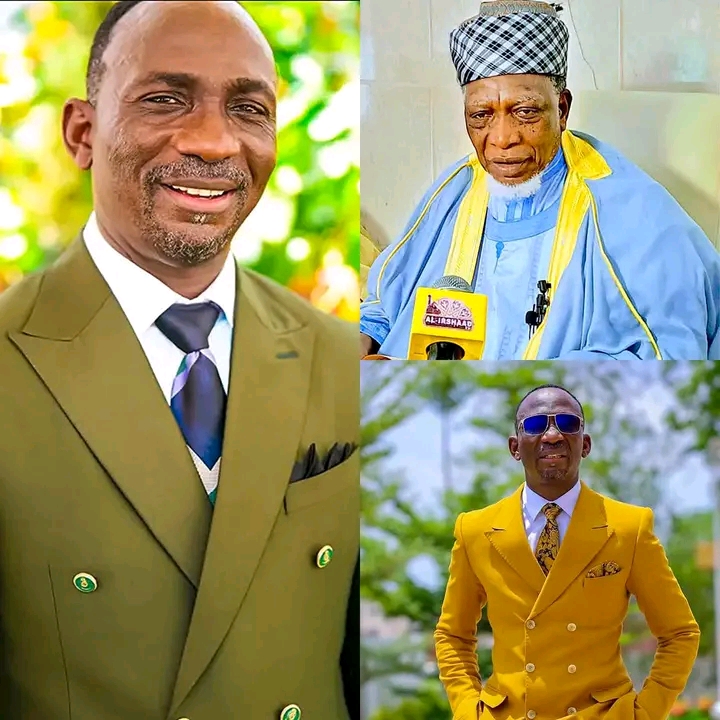
The long-running debate over whether Christians or Muslims constitute the larger religious population in Nigeria has resurfaced, with Senior Pastor of Dunamis International Gospel Centre, Dr. Paul Enenche, calling for an approach he believes could finally replace competing claims with verifiable data.
Enenche argued that the Federal Government should conduct a credible national population census that allows Nigerians to voluntarily indicate their religious affiliation.
The pastor made the call during a Sunday sermon at the church's headquarters in Abuja, while reacting to recent comments by Islamic cleric Sheikh Yahya Jingir, who reportedly claimed that Muslims are more numerous than Christians in Nigeria.
Rather than allowing the argument to continue as a contest of competing estimates, Enenche suggested that a properly conducted census could provide a clearer picture of Nigeria's religious demographics.
> “If you think you are superior, why didn't you people allow for the census all these while?” Enenche asked.
Why Nigeria's Religious Numbers Remain Controversial
Nigeria is one of the world's most religiously diverse countries, with Christianity and Islam representing the two largest faith traditions, alongside followers of traditional African religions and Nigerians who do not identify with any religion.
Yet, determining the exact size of each religious population has remained difficult.
Nigeria's population census has historically focused on demographic and socioeconomic information, while religion and ethnicity have generally been excluded from official census enumeration.
That absence of official religious data has created room for different organisations, researchers and religious leaders to rely on surveys, estimates and projections.
The result is an argument that can quickly become politically and emotionally charged.
One side produces figures suggesting a Christian majority.
Another presents estimates indicating a Muslim majority.
Neither position can easily point to a recent official Nigerian census that conclusively settles the matter.
Enenche Wants the Numbers Tested
Enenche's intervention therefore shifts the argument from “Who has more people?” to “Why don't we have reliable data?”
His position is that Nigerians should be allowed to identify their religious affiliation through a credible process, rather than allowing religious leaders to settle the question through public declarations.
The pastor also warned against what he described as taking Christians and the Christian church for granted, stressing that Christians have a significant presence across the country.
The comments are likely to generate further discussion because religion in Nigeria extends far beyond personal belief.
It influences politics, community relations, education, social organisations and, at times, public policy.
This makes accurate demographic information particularly sensitive.
But Should Religion Actually Be Included in a Census?
There is a strong argument in favour of collecting the information.
Reliable religious demographic data could help researchers, policymakers and social planners understand the country's population more accurately and could reduce speculation.
However, there is also a legitimate question about privacy and the purpose of census data.
A census is primarily intended to provide demographic information for planning and development. Collecting sensitive identity information can create concerns about how such information would be stored, protected and eventually used.
Nigeria would therefore need strong safeguards if religious affiliation were ever incorporated into a future population exercise.
Participation would also need to be voluntary and designed in a way that prevents discrimination against people based on their answers.
The Bigger Issue Is Beyond Christianity and Islam
Perhaps the most important lesson from the renewed debate is that Nigeria should be careful about turning population figures into a competition for superiority.
Whether Christians eventually prove to be more numerous than Muslims, or Muslims prove to be more numerous than Christians, the outcome should not determine whose life matters more.
Nigeria belongs equally to Christians, Muslims, traditional worshippers, people of other faiths and those who do not subscribe to religion.
Population numbers should therefore be useful for understanding society—not weapons for determining political or religious dominance.
The country also needs better demographic information generally, including accurate data on population distribution, employment, education, housing, healthcare and migration.
A credible census could provide valuable information in these areas.
The question raised by Pastor Enenche is consequently larger than the current Christian-Muslim argument.
Should Nigeria finally collect reliable information about religious affiliation, with appropriate privacy safeguards, so that public debate is based on evidence rather than competing claims?
For a country of more than 200 million people, knowing who we are—and how we are distributed—should be a matter of national planning, not merely a religious contest.
Southern Report will continue to follow the debate as religious leaders, policymakers and Nigerians respond to the call.
Discussion (0)
Sign in to join the discussion.
Log InBe the first to comment on this story.